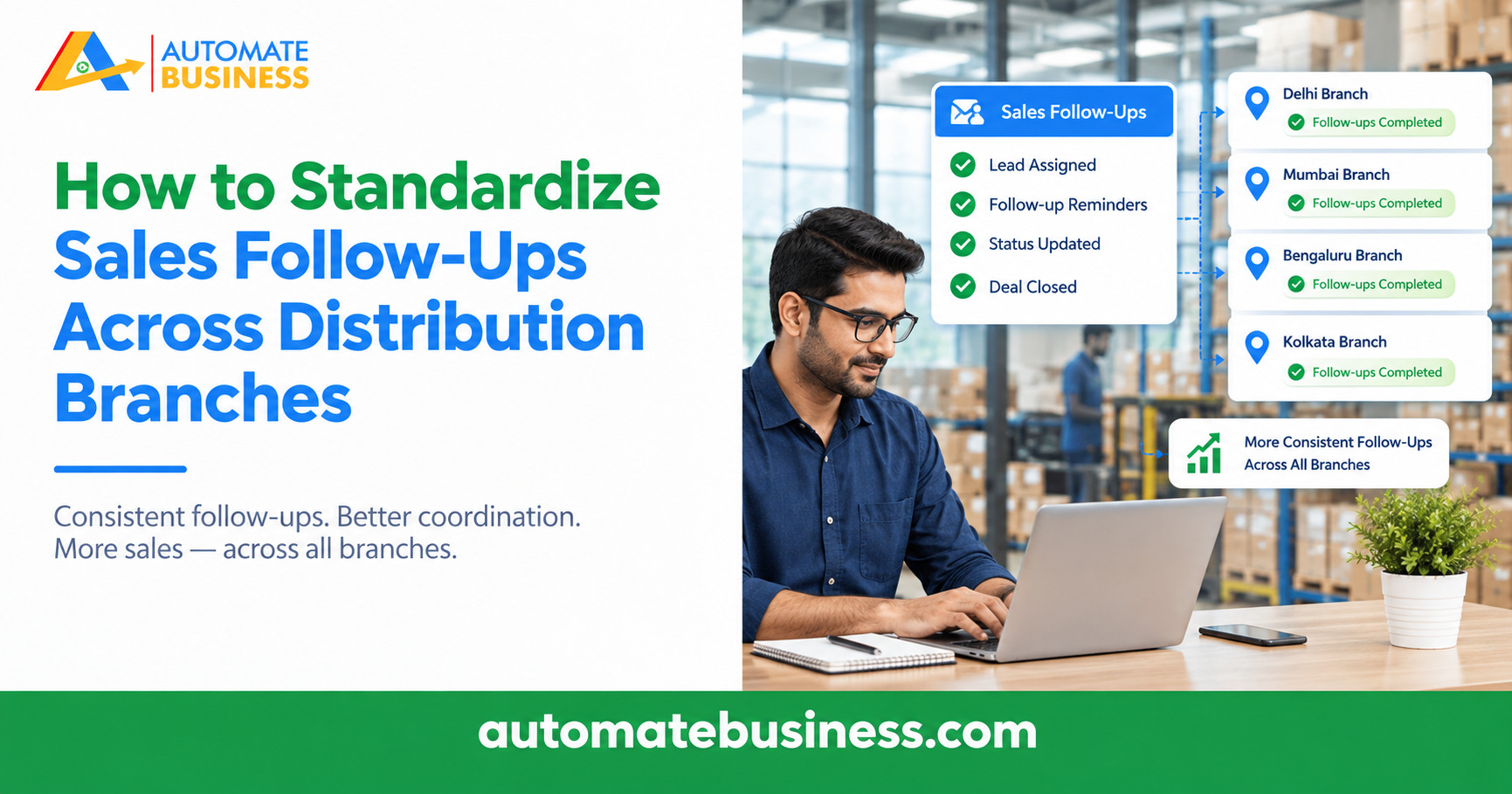
How to Standardize Sales Follow-Ups Across Distribution Branches
Standardize sales follow-ups across distribution branches with one CRM, unlimited users, and automated reminders—so no lead gets missed.
Join the 1 Day Live Hackathon

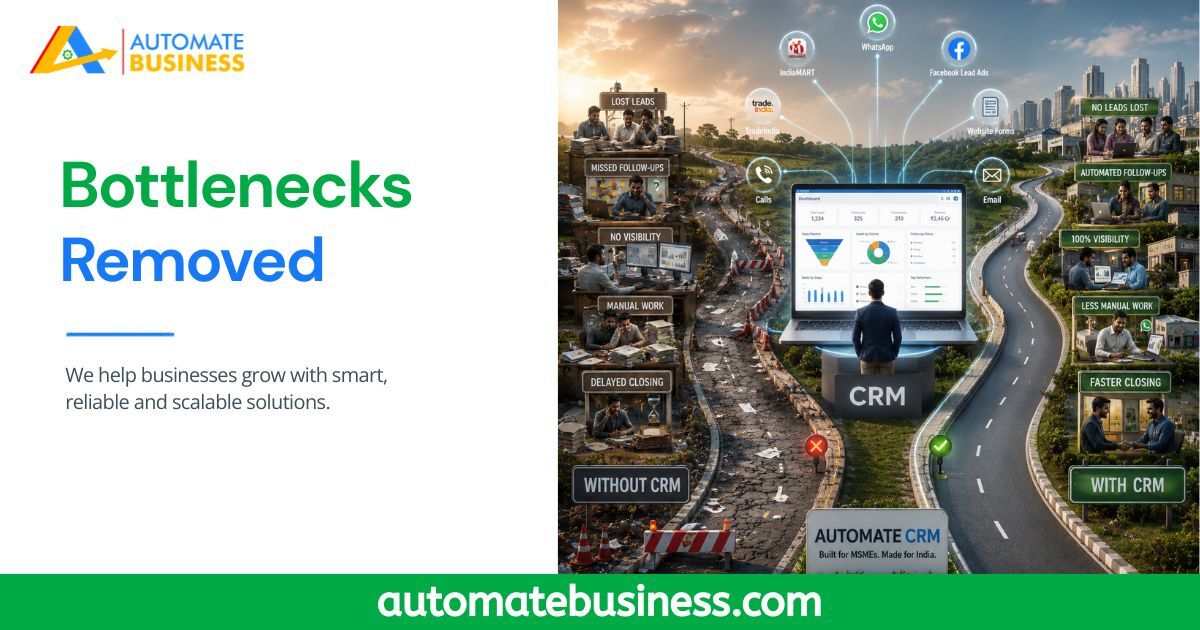
Every growing business hits the same wall at some point. Leads are coming in from IndiaMART, Facebook, WhatsApp, and referrals but somehow, deals are still slipping through. Salespeople say they're "on it." Managers say they "don't have visibility." And the owner is stuck checking spreadsheets at 11 PM trying to figure out which lead is stuck where.
This isn't a sales problem. It's a process problem. And most sales processes break down at the same five points, regardless of industry or team size.
In this blog, we'll break down the five most common sales process bottlenecks, why they happen, and how a well-built CRM like Automate CRM removes each one, without adding more work for your team.
Bottleneck1:- Leads Get Lost Between Capture and Contact.
The first place deals die is right at the start. A lead comes in through IndiaMART, a Facebook ad, a website form, or a walk-in enquiry and it sits in someone's inbox, notebook, or Excel sheet until someone remembers to follow up. By the time contact happens, the buyer has already spoken to a competitor.
This happens because most businesses treat lead capture as a manual, human-dependent step. There's no single place where every lead regardless of source lands automatically with full context.
How a CRM fixes this:- A CRM should pull leads directly from every source into one pipeline, tagged with the source, so nothing depends on someone remembering to copy-paste. Automate CRM connects directly with IndiaMART, TradeIndia, Facebook Lead Ads, website forms, webhooks, and REST APIs, so every enquiry lands in the right pipeline within seconds of being generated with source, product interest, and contact details intact.
Bottleneck 2: Follow-Ups Depend on Memory, Not a System.
Ask any sales manager what's costing them the most deals, and the answer is almost always the same: follow-ups that didn't happen on time. A rep gets busy, forgets to call back, or loses track of who said "call me next week." Multiply that across 30–50 active leads, and the leakage becomes massive.
Follow-up failure isn't a discipline problem it's the absence of a system that reminds, schedules, and nudges automatically.
How a CRM fixes this:- Automated follow-up scheduling removes the dependency on memory entirely. Automate CRM lets teams set auto follow-ups, overdue alerts, and calendar-based reminders, and can trigger WhatsApp or email templates automatically the moment a lead moves to a specific stage — so a reminder to call back doesn't rely on anyone's memory, it just happens.
Bottleneck 3: One Generic Sales Process for Every Product or Team
Many businesses run every single lead regardless of product, team, or branch through the same rigid sales flow. A software enquiry gets treated the same way as a bulk hardware order. A real estate lead follows the same stages as an AMC renewal. This forces reps to work around the system instead of with it, and managers lose the ability to see meaningful, stage-wise performance.
How a CRM fixes this:- The right CRM should let you build separate pipelines for separate products, branches, or teams each with its own stages, without duplicating effort or losing centralized visibility. Automate CRM supports multiple pipelines with fully custom stages, open/closed statuses, and role-based access, so a "Hardware Sales" pipeline and a "Software CRM" pipeline can run independently, visible only to the teams that need them.
Bottleneck 4: Managers Have No Real Visibility Without Chasing Updates
"Where are we with the Mehta lead?" "Which reps are behind on follow-ups this week?" "How many leads did we close from IndiaMART versus Facebook this month?" If answering these questions means pinging five people on WhatsApp, the sales process has a visibility bottleneck and it's costing management time that should be spent on strategy, not status-checking.
How a CRM fixes this: Reporting has to be built into the system, not chased manually. Automate CRM gives owners and managers dashboard-level reporting by salesperson, source, stage, product, date, city, and state so performance reviews take minutes instead of a full afternoon of follow-up calls.
Bottleneck 5: Closing Happens Outside the CRM
Even when everything else works, many teams still lose the last mile: sending quotations over email, sharing payment links over WhatsApp, and confirming payment through a screenshot none of it logged anywhere. The deal closes, but the CRM has no record of how it got there, which breaks reporting and makes repeat business harder to track.
How a CRM fixes this: Closing should happen inside the same workflow as the rest of the sales process. Automate CRM lets teams generate payment links through Razorpay, send quotations and communication, and move a deal through to "Won" all from within the lead record so the full lead-to-cash journey stays in one place, fully traceable.
Why Automate CRM Is Built Differently for Indian MSMEs
Most CRMs available in the market are built for global SaaS teams and then adapted for India. That shows up in small but painful ways no real IndiaMART or TradeIndia integration, WhatsApp treated as an afterthought, and pricing or setup that assumes a large in-house IT team.
Automate CRM is built the other way around — for Indian manufacturers, traders, distributors, and service businesses first:
The result, based on businesses already using it: 12,000+ MSMEs across 35+ industries have used Automate CRM to move sales tracking off spreadsheets and WhatsApp chats, with reported revenue growth of 1.5x–1.6x and over 2 hours a day saved on manual admin work.
Fix Your Sales Process, Not Just Your Sales Team
Most sales teams aren't underperforming because of effort—they're underperforming because the process around them has gaps. Leads get lost, follow-ups get forgotten, visibility disappears, and closing happens outside the system that's supposed to track it.
A CRM built for how your business actually works closes those gaps without adding extra work for your team.
Book an Automate CRM demo and see exactly where your current sales process is leaking and how to plug it.
Get more insights every week. Join Kewal's free WhatsApp community for live sessions and automation tips.
Join 12,000+ MSMEs who automated their business. Join the 2 day live hackathon today.